Checklist: Conducting a factory inspection in China
A factory inspection is more than a tour of machines and a meeting with sales staff. Buyers should verify the site and process relevant to the order, observe actual work, trace records, and document what was not accessible. A consistent checklist helps teams compare evidence across visits while keeping the conclusions within the inspection scope.
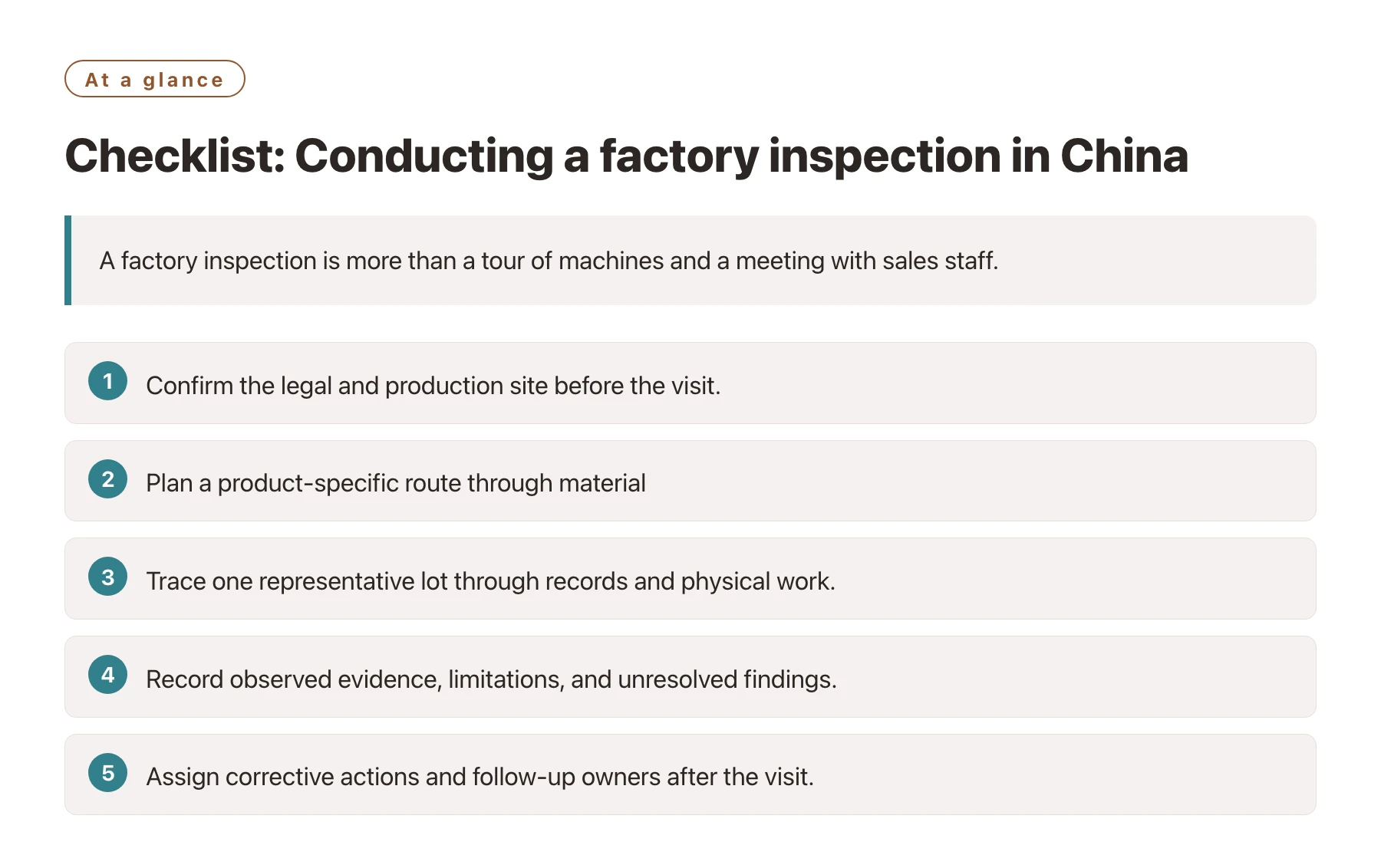
Key takeaways
- Confirm the legal and production site before the visit.
- Plan a product-specific route through material, process, inspection, and packing.
- Trace one representative lot through records and physical work.
- Record observed evidence, limitations, and unresolved findings.
- Assign corrective actions and follow-up owners after the visit.
Prepare questions and records before arrival so time on site is spent validating real operations rather than collecting brochures.
1. Set the purpose, scope, and visit team
Define why the visit is needed: supplier qualification, process review, capacity check, quality follow-up, or investigation. List products, processes, site, relevant standards or buyer criteria, and decisions the visit will support. Identify buyer participants and any interpreter or technical specialist.
State exclusions and limits. A short visit cannot audit every process, verify every record, or certify compliance. Name the decision owner and set a method for escalating a critical finding during the visit.
2. Confirm site identity and access
Verify factory name, address, production scope, and relationship to the contracting party. Ask whether production occurs at other buildings or subcontractors. Record departments or processes not included in the visit and whether another site will make the order.
Arrange site authorization, personal protective equipment, safety briefing, photography rules, visitor log, and required contacts. Confirm that relevant staff and records will be available. Follow site safety instructions and do not enter restricted areas without authorization.
3. Prepare product and process references
Bring product codes, drawings, material requirements, approved samples, packaging details, purchase orders, and prior findings. Identify critical characteristics and process steps associated with likely failure modes. Prepare a list of questions that can be answered by observation or records.
Use controlled revisions and record any discrepancies between the buyer’s file and factory documents. Ask who approves updates. An outdated drawing at the line can be more informative than a polished presentation because it reveals a version-control gap needing follow-up.
4. Walk the material flow and storage areas
Follow product inputs from receiving and storage toward production. Observe identification, lot segregation, environmental protection, status labels, handling, and movement of rejected or unverified materials. Trace selected inputs to a current work order where records allow.
Ask how workers know which materials are approved and what happens when quantities, documents, or condition do not match. Note congestion, mixed status, damage, or exposed materials, but record facts rather than assuming a cause without evidence.
5. Observe production and operator controls
Watch a representative process under normal conditions. Compare work instructions, tooling, equipment, sequence, operator practice, in-process checks, rework, and line clearance with the approved process. Ask operators to explain relevant controls and where they record results.
Record product, line, time, work order, and revision observed. A staged demonstration may not represent ordinary production; identify whether a live order or standard setup was available. Ask how process adjustments are authorized and communicated to later shifts.
6. Review inspection, testing, and nonconforming work
Examine inspection points, criteria, gauges, test equipment, calibration status where relevant, sample basis, and records for a selected lot. Ask who evaluates borderline results and how failed goods are identified, contained, reworked, or rejected.
ISO 9001 describes quality management system requirements and documented information; a certificate alone does not prove product conformity or effective controls at every site. Review relevant examples and verify that evidence matches the inspected process, product, and period. [1]
7. Trace a lot through records and shipment
Select a finished or in-process lot and trace identifiers backward to material receipt and forward to inspection, packing, and dispatch records. Check product identity, dates, quantities, revision, disposition, and responsible roles for consistency.
Ask how records are corrected and retained. Where an operation is outsourced, determine how the originating factory links external work to the finished lot. Note gaps in traceability and clarify whether they affect the order under review.
8. Check capacity and order scheduling evidence
Review current order loading, equipment availability, shift plan, staffing, bottlenecks, material lead time, and recent output for comparable work. Verify whether the proposed order shares resources with other commitments. Ask how the schedule is updated when a milestone slips.
Distinguish installed capacity from open capacity and historical output from future promise. Record assumptions involving overtime, new equipment, subcontractors, or unconfirmed materials. Agree what evidence is needed before the buyer accepts a delivery commitment.
9. Record findings and close the visit
For each finding, include requirement or question, observed evidence, location, record reference, risk, owner, due date, and requested proof. Separate confirmed nonconformity from concern or information request. Photograph only where authorized and link each image to context.
Hold a closing discussion to confirm factual accuracy, immediate containment, and follow-up timing. Do not remove or soften a critical finding solely because it is uncomfortable. Provide the final report to responsible technical, quality, and procurement owners.
10. Decide qualification and follow-up steps
Summarize scope, evidence, strengths, gaps, inaccessible areas, and recommendations. Assign corrective actions and decide whether the supplier is approved, conditionally approved, or requires another visit or document review. Keep a clear record of conditions and expiry.
Buyers conducting Shanghai JS Sourcing can connect site observations to supplier qualification and order controls. Reassess after a new site, process, ownership, subcontractor, serious quality issue, or major product change rather than relying indefinitely on an old visit report.
Sources
Frequently asked questions
Should a factory inspection be announced in advance?
Choose notice based on the visit purpose, access needs, contract rights, and whether ordinary operations must be observed.
Can a factory visit certify a supplier?
No. It provides evidence within the defined scope and date; qualification needs documented criteria and follow-up.
What should inspectors record when an area is inaccessible?
Identify the excluded process, reason, evidence unavailable, potential impact, and required follow-up.
How should findings be closed?
Assign an owner and due date, request objective evidence, and verify correction before changing status.