Writing a Luxury Fragrance Brief That Survives Manufacturing
A luxury fragrance brief is not a description of a mood; it is a translation document that turns creative intent into constraints a perfumer and a production line can act on. Briefs that fail usually fail in the same way: they describe how the product should feel to a customer without describing what the formula must do at hour four. Getting those two things into one page is what separates a direction that develops smoothly from one that is reworked for months.
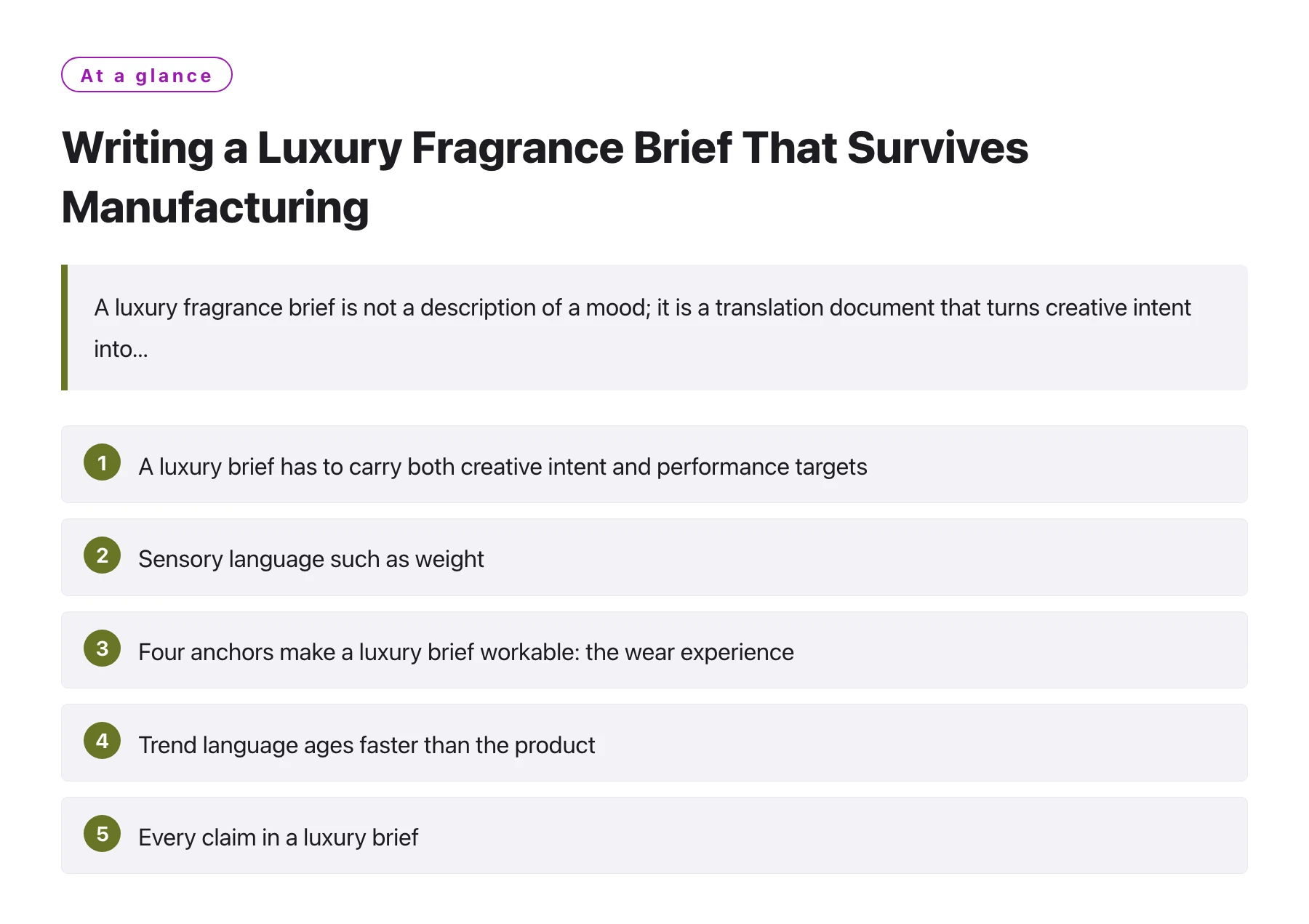
Key takeawaysA luxury brief has to carry both creative intent and performance targets, because the perfumer can only act on the second and the brand only cares about the first. · Sensory language such as weight, temperature, texture and timing maps onto materials far better than adjectives such as modern, premium or expensive. · Four anchors make a luxury brief workable: the wear experience, the selling markets, the unit cost ceiling and the pack the formula will live in. · Trend language ages faster than the product, so a brief should describe the experience it wants rather than the movement it is following. · Every claim in a luxury brief, including sustainability, needs a supply-chain answer before the brief is sent rather than after the launch.
Luxury is a positioning, and positioning is built by choices: which materials are used, how much of them, what the bottle weighs, how the scent reveals itself over an evening. A brief is where those choices are written down before they become expensive.
This guide covers why adjectives fail, what a luxury brief has to contain, and how to review a draft before it reaches a perfumer.
The gap between a mood and a brief
Creative teams are trained to describe feelings; perfumers are trained to work with materials. A brief sits between those two languages, and most of its value comes from translating rather than from describing.
Why adjectives fail
Words such as modern, premium, clean or expensive describe a judgement rather than a sensation, and two people in the same meeting will hear them differently. Sensory language works because it points at physical properties: how heavy the scent feels, how warm or cool it reads, how quickly it opens, how long it stays close to the skin.
Perfumery education bodies such as The Fragrance Foundation exist to support professional standards in the craft, and the vocabulary they teach is precisely the vocabulary a brief should borrow [3].
The four anchors of a workable brief
Every effective luxury brief answers four questions: what the wear experience should be at the start and after several hours, which markets the product will be sold in, what the unit cost ceiling is, and what pack and format the formula will live in.
Those four anchors constrain each other. A cost ceiling limits the material palette, the pack changes how the formula reads, and the market determines which materials are usable at all. Writing them down together prevents the brief from asking for something the project cannot deliver.
Where a luxury positioning actually comes from
Luxury formulas rarely succeed by adding more ingredients. They succeed by choosing a small number of distinctive materials and giving them room. The major fragrance houses publish extensively on how they develop ingredients and segment their portfolios, and that material logic is the part of a luxury product that a customer perceives without being able to name it [1].
Drafting the brief in one sitting
- Write the wear target firstDescribe when the scent should be noticed, how far it should carry and how it should read after several hours.
- Name the markets and the retail contextSelling markets determine labelling, restrictions and how the formula will be experienced in local conditions.
- State the cost ceiling per unitAn honest ceiling lets the perfumer choose materials deliberately instead of discovering the limit after sampling.
- Fix the pack and the formatBottle, closure and carrier change how a formula reads, so they belong in the brief rather than in a later conversation.
- List the references and say what they are forMark each reference as an example of weight, of opening or of overall character, so it is not copied literally.
- Name the person who signsOne decision maker with authority keeps sampling rounds short and comments consistent.
The most expensive sentence in fragrance development is a variation of this one: we will know it when we smell it. It sounds like creative openness and behaves like an open-ended project, because it transfers the decision from the brand to the lab. A brief does not have to be right; it has to be specific enough to be proven wrong. If the first direction round misses, a specific brief tells you which part of the target moved. If the brief was never specific, every sample is a fresh guess, and the project pays for that in rounds rather than in materials.
Vague phrasing and the production-ready version
| Brief line | Vague phrasing | Production-ready phrasing | What it protects |
|---|---|---|---|
| Character | Modern and premium | Warm woods with a soft opening, close to the skin after two hours | Material choices that can actually be costed |
| Strength | Strong but not overpowering | Noticeable within arm's reach for the first hours, then a skin scent | A wear target the perfumer can test against |
| Market | Global launch | Named launch markets with their labelling requirements | Avoids a reformulation before the first shipment |
| Cost | Competitive for the category | A stated unit cost ceiling for the compound and the pack | Prevents sampling above the achievable price |
| Format | Eau de parfum in a glass bottle | A defined fill volume, closure type and carrier | Removes the guesswork that changes how the scent reads |
Rewriting the second column into the third is the single most useful hour a brand can spend before sampling. It also makes the brief reviewable by somebody outside the creative team, which is how mistakes get caught early.
Reviewing the brief before it is sent
A brief is worth reading twice: once as a perfumer who has to act on it, and once as a project manager who has to schedule it.
Check the brief for actable sentences
Go through the document and mark every sentence that a perfumer could test. If a paragraph contains none, it is context rather than instruction, and it should be labelled that way so nobody mistakes atmosphere for a requirement.
A luxury fragrance manufacturer will usually ask for the same four anchors back, and will say so early if one of them is missing. That early pushback is a good sign, not an obstacle.
Test every claim against the supply chain
Luxury briefs often carry claims about sustainability, origin or innovation. Each one needs an answer that survives a question from a retailer. Houses such as dsm-firmenich publish on ingredient innovation and sustainability programmes, which is the kind of evidence a claim has to rest on [2].
Trend language deserves similar scepticism. Consumer research organisations such as Mintel publish category-level trend work rather than individual taste predictions [4], and a brief that describes an experience will outlive one that describes a trend.
Keep the brief alive, but controlled
A brief is a working document, and updating it as the project learns is normal. What matters is that changes are dated and versioned, so the perfumer always works from the current target and the brand can see how far the target has moved from the original intent.
Sources
- Givaudan —— One of the largest fragrance and flavour houses; public material on fragrance creation, ingredient portfolio and market segments.
- dsm-firmenich —— A global fragrance, flavour and nutrition company; public information on perfumery, ingredients and sustainability programmes.
- The Fragrance Foundation —— A non-profit organisation for the fragrance industry, running perfumery education programmes and industry recognition.
- Mintel Press Centre —— Mintel's press releases on consumer and beauty market research, including fragrance and personal care trend reporting.
Frequently asked questions
What should a luxury fragrance brief include?
Four anchors and one creative direction: the wear experience at the start and after several hours, the selling markets, the unit cost ceiling, the pack and format, and a sensory description of the character with references labelled by what they illustrate. Everything else is context and should be marked as such.
How long should a fragrance brief be?
Long enough to remove ambiguity and short enough that a perfumer can act on it without interpretation. One page of specifics plus one page of context is usually sufficient. A longer brief is not a better brief if it repeats the same intent in different words.
Should the brief mention a competitor's product?
It can, as long as it says what aspect is relevant: the weight of the dry-down, the pace of the opening, the sweetness level. Naming a competitor without that framing usually produces an imitation rather than a distinct product, which is rarely what a luxury positioning needs.
Who should write the fragrance brief?
Usually the person closest to the product decision, with input from whoever owns the commercial constraints. The important part is not the author but the sign-off: one person should hold the final call, and that person should be named in the brief itself.
Can a brief be changed after sampling begins?
It can, but each change resets part of the work already done. Changes are cheapest when they are made against a versioned brief, so the perfumer knows exactly which target has moved. Late changes are the most common reason a fragrance project runs long.