How Do You Choose the Right Wholesale Coffee Packaging Supplier?
Choose a wholesale coffee packaging supplier by matching the bag to your coffee, filling process, sales volume, and shelf-life target. Ask for the exact material structure, oxygen and moisture barrier data, valve specification, seal performance, food-contact documentation, MOQ, production lead time, and landed cost. Test at least 3 samples with real coffee before approving a large run. For U.S. sales, confirm that every food-contact component is authorized for the intended use; FDA notes that packaging compliance depends on the individual substances and conditions of use. Compare suppliers using the same specification, then review repeat-order consistency, capacity, printing control, logistics, and defect handling before moving to larger volumes.
Start with the coffee specification because a supplier cannot quote the right bag from weight alone. Record whether the product is whole bean or ground, whether the retail sizes are 250 g, 340 g, 500 g, or 1 kg, how long the coffee should remain in marketable condition, and whether filling is manual or automated. A 250 g pouch used by a small roaster may run under very different conditions from a 1 kg bag packed on a commercial line.
Roasted coffee packaging normally needs protection from oxygen, moisture, light, and outside odors while allowing carbon dioxide produced after roasting to escape. A practical RFQ should therefore include at least 8 fields: bag size, structure, thickness, valve, zipper, finish, print method, and required quantity. That level of detail reduces the chance of receiving three quotations for three different products.
“Quote the same technical specification from every supplier before comparing unit prices.”
The material structure deserves more attention than the outer appearance. A coffee pouch may use combinations of polyester, polyethylene, foil, metallized film, paper, or other layers, with each layer serving a different purpose. Two bags can look almost identical on a screen while having different barrier and sealing properties.
Ask the supplier to provide the actual layer structure and the available technical data for oxygen and moisture transmission. Do not accept “premium barrier” or “high protection” as a complete specification. Request the test method, units, test conditions, and material thickness so that a quotation from Supplier A can be compared with Supplier B.
A simple comparison table can make technical gaps visible:
| Item | Supplier A | Supplier B |
|---|---|---|
| Bag size | 250 g | 250 g |
| Film structure | Specified | Specified |
| Thickness | 140 μm | 120 μm |
| Valve | One-way | One-way |
| MOQ | 10,000 | 30,000 |
| Sample quantity | 5 | 5 |
| Lead time | 18 days | 28 days |
Using 5 physical samples per supplier is a practical minimum for checking dimensions, zipper alignment, valve placement, print quality, and seals. A larger review with 20 samples gives a better picture of production variation, especially before a 50,000-unit purchase.
The valve should be reviewed separately because its placement and installation can affect filling and package appearance. Ask for valve diameter, installation position, material specification, and inspection method. Then fill the bag with the intended coffee and check the package after 24 hours, 72 hours, and 7 days.
Seal performance is just as important as film selection. A pouch that looks good but seals inconsistently can create rework during packing. Ask the supplier for the recommended sealing temperature, pressure, and dwell conditions, then test those settings on the same equipment used in production.
For an automated line, dimensional tolerance deserves written limits. A difference of even 2–3 mm in width, gusset depth, or zipper position can affect machine feeding depending on the equipment. Ask the supplier to define acceptable tolerances rather than writing only “standard size.”
The purchasing cost should then be calculated beyond the factory quotation. Suppose a supplier offers 20,000 bags at $0.18 each. The packaging cost shown on the quotation is $3,600, but the delivered cost can change after setup fees, freight, inspection, customs charges, local transport, and rejected units are included.
A better worksheet should contain at least 10 cost fields:
-
Bag unit price
-
Printing setup
-
Valve cost
-
Sample cost
-
Tooling or plate charges
-
Freight
-
Insurance
-
Customs or import charges
-
Local delivery
-
Estimated defective units
A 2026 purchasing review can also compare inventory efficiency. If a roaster uses 4,000 bags each month and orders 40,000 units, the packaging covers about 10 months of use. That may reduce unit price but can tie up more cash and warehouse space than a 12,000-unit order placed three times per year.
MOQ becomes more relevant when a brand has several SKUs. Ten coffee products using 10,000 bags each creates a nominal purchase of 100,000 bags. If monthly sales average only 1,200 bags across smaller products, some printed inventory can remain for more than 8 months.
Printing should be assessed with physical samples, especially when the design contains small text, fine lines, muted colors, gradients, or matte finishes. Ask for at least 3 reference samples printed on the proposed material, because the same artwork can look different on white film, metallized film, paper-look laminate, or kraft-effect structures.
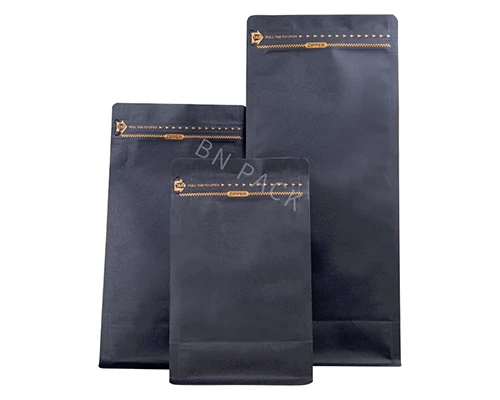
When a roaster wants a natural visual style, kraft coffee bags can be considered, but the outer paper appearance should not be confused with the full barrier structure. The supplier should state whether the kraft layer is structural, decorative, or laminated to a high-barrier inner film.
For U.S. distribution, ask the supplier for food-contact documentation covering the finished packaging components. FDA explains that the regulatory status of a food-contact article depends on the individual substances that make up the article and their intended conditions of use. FDA also states that food-contact substances may need to be covered by regulations, an effective Food Contact Substance Notification, GRAS status, prior sanction, or another applicable route.
That check should include more than the main film. Adhesives, coatings, inks, seal layers, valves, and other components may form part of the food-contact material system. FDA identifies packaging and packaging-related substances such as adhesives and colorants as food-contact substances, so a supplier that provides only a generic “food grade” statement is giving less information than a buyer may need.
Lead time should also be broken into stages rather than accepted as one number. A quotation saying “30 days” could mean 30 days from deposit, 30 days after artwork approval, or 30 days after sampling. Ask suppliers to state the timeline for artwork confirmation, proofing, production, inspection, packing, and shipment.
For example, a workable schedule might be 3 days for artwork confirmation, 5 days for sampling, 18 days for production, and 7–12 days for delivery. Those numbers should be treated as supplier-specific estimates, not industry standards, and written into the purchase record for each order.
A first commercial order can be used to assess repeat consistency across the whole process. Record the actual received quantity, rejected quantity, print defects, seal problems, zipper issues, missing valves, damaged cartons, and delivery date. Testing 1,000 bags from the first shipment gives more useful production information than inspecting only 10 bags from one carton.
Ask what the supplier will do when the delivered quantity or specification does not match the approved sample.
A supplier's production capacity should also match projected volume. A company ordering 8,000 bags per month may need a very different supplier profile from one ordering 150,000 bags per month. Ask for normal monthly capacity, peak-season capacity, current lead times, and whether repeat orders use the same approved material structure.
Communication during sampling is another useful indicator. A supplier should be able to answer questions about film layers, valve placement, dimensions, sealing conditions, printing, carton packing, and shipping terms with measurable information. Four or five rounds of vague replies can create more delay than a supplier with a slightly higher quotation but clearer technical documentation.
The final supplier comparison can be kept to a one-page scorecard:
| Measure | Suggested review |
|---|---|
| Barrier data | Test method + specification |
| Dimensions | Tolerance in mm |
| Valve | Type + placement |
| Seal | Test conditions |
| MOQ | Per SKU |
| Printing | Sample approval |
| Lead time | Production + shipping |
| Compliance | Food-contact documents |
| Logistics | Delivered cost |
| Capacity | Monthly output |
| Quality | Defect records |
| Repeat orders | Specification consistency |
Use the same coffee, same fill weight, and same sealing equipment when checking samples. A 250 g bag filled by hand may perform well, while the same bag can behave differently on equipment running 60–100 packs per minute because feeding, opening, and sealing happen under more controlled mechanical conditions.
A supplier can then be assessed using actual operating results instead of presentation samples alone. One packaging buyer may prioritize a 5,000-unit MOQ because the business is adding new coffees every quarter; another may place 100,000-unit orders because a small unit-price difference matters at high volume. The supplier specification should fit the purchasing model rather than force every coffee business into the same package.
For each approved SKU, keep a written record of dimensions, material structure, thickness, valve, zipper, finish, artwork version, print method, packing quantity, tolerances, and shipping terms. In 2026, this record is especially useful when several suppliers quote similar bags or when a brand adds a second production location.
The supplier should also understand that a sample approval is not permission to substitute materials without notice. A change from one film structure to another, a different valve source, or a different zipper can alter package performance even when the finished bag looks nearly identical.
Before placing the first large order, compare at least 3 suppliers, inspect 5–20 samples from each, calculate the delivered cost, and record the agreed specification. A supplier that meets the material, quality, lead-time, documentation, and volume requirements can then be evaluated again after the first commercial shipment using measured results rather than the original sales quotation.